
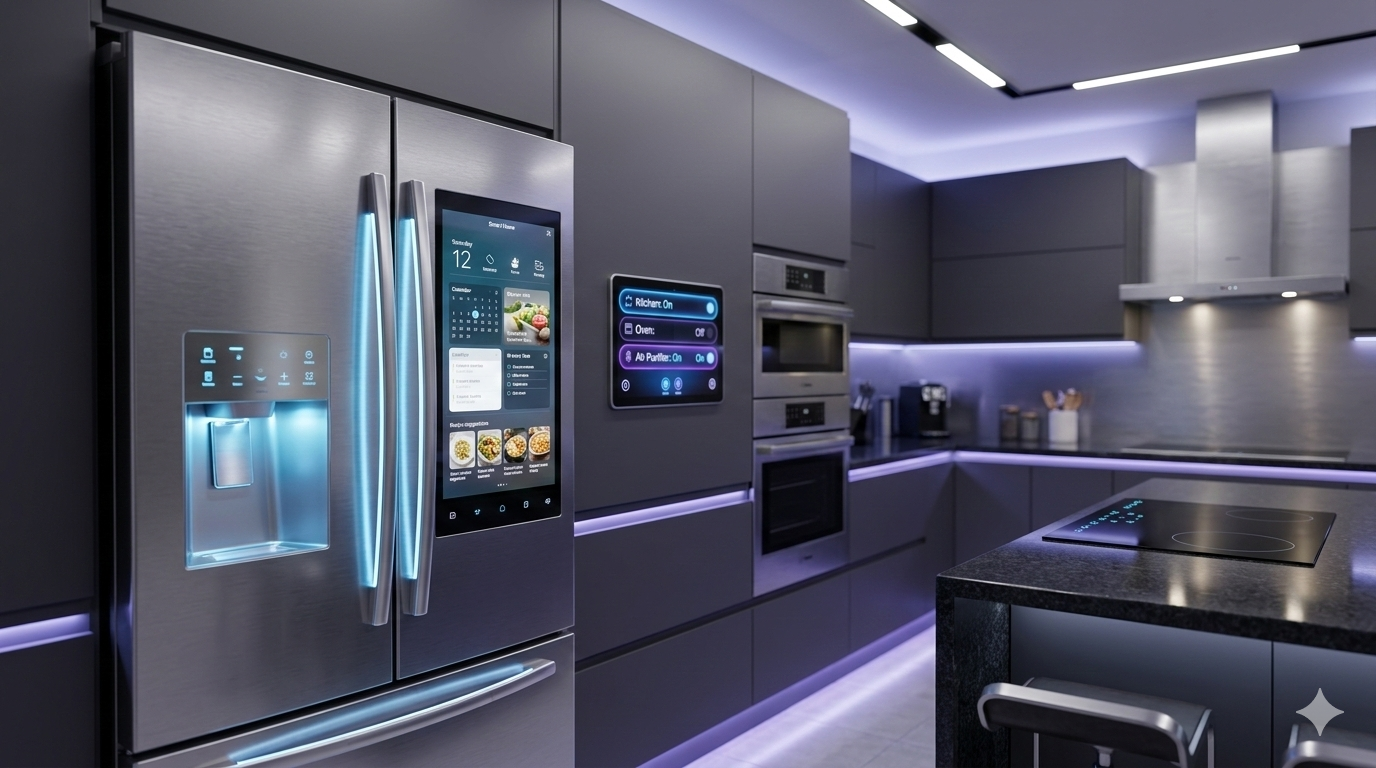
Exploring The Latest Innovations In Refrigerators
From AI Hybrid Cooling To Smart Food Management — The Complete Innovation Guide | TechCM Electronics Store Africa | 2025–2026
The refrigerator has kept food cold and safe for generations — but in 2025 and 2026, it has become something far more than an insulated box with a compressor. Artificial intelligence, IoT connectivity, advanced sensor technology, voice control, built-in cameras, touchscreen displays, hybrid cooling systems, and eco-friendly refrigerants have converged to transform the refrigerator into one of the most technologically sophisticated appliances in the modern home. At CES 2025 and CES 2026, the world’s leading home appliance brands — Samsung, LG, GE, Whirlpool, Bosch, and Haier — unveiled refrigerator innovations that would have seemed like science fiction a decade ago. For African households in South Africa, Nigeria, Kenya, Ghana, Egypt, Tanzania, and beyond — where reliable food preservation is a daily priority given warm climates, load shedding challenges, and the importance of reducing food waste in households managing tight budgets — understanding and investing in the right modern refrigerator is more important than ever. At TechCM, Africa’s number one electronics store, we have compiled the most comprehensive guide to the latest refrigerator innovations, the best refrigerators of 2025 and 2026, and what African consumers specifically need to know when choosing a new fridge.
Why The Refrigerator Is The New Frontier Of Home Innovation
Of all the home appliances in a modern household, the refrigerator is the only one that runs continuously, 24 hours a day, 365 days a year, without interruption. It is the most energy-intensive appliance in the average home, consuming between 10 and 15 percent of total household electricity over the course of a year. It is also the appliance most directly connected to one of humanity’s most fundamental concerns — the freshness, safety, and availability of food. These realities explain why the global appliance industry has invested so heavily in refrigerator innovation in recent years: the combination of continuous operation, high energy consumption, food safety implications, and the central role of the kitchen in family life makes refrigerators an extraordinarily rich target for AI, IoT, and sensor-driven improvement.
The pace of refrigerator innovation accelerated dramatically between 2024 and 2026. At CES 2025 in January, Samsung unveiled its AI Hybrid Cooling technology — a genuine engineering leap that uses a semiconductor-based Peltier module alongside the traditional compressor to deliver hybrid cooling that functions like the powertrain of a modern hybrid car. At CES 2026 in January, GE Appliances revealed its Kitchen Assistant smart refrigerator — featuring the world’s first built-in barcode scanner for automatic grocery list management, a flush-mounted AI camera for real-time crisper drawer visibility, and hands-free water dispensing. LG Electronics introduced machine-learning-powered food inventory management in October 2025, building on its AI ThinQ platform. These are not concept demonstrations. They are commercially available or imminently arriving products that represent the cutting edge of what your next refrigerator could do for your home.
The 8 Biggest Refrigerator Innovations Of 2025–2026
Samsung’s AI Hybrid Cooling technology — unveiled at CES 2025 and now rolling out globally — represents the most significant engineering advancement in domestic refrigerator cooling since the transition from freon to modern refrigerants. The system combines Samsung’s highly efficient AI Inverter Compressor with a Peltier module: a semiconductor device that generates cooling through the thermoelectric effect — the temperature change that occurs when electric current flows through the junction of two different conducting materials. The Peltier module operates without any moving parts, produces no vibration, and activates only when the AI algorithm determines that supplementary cooling is required — such as when a large grocery load is added, when hot food is stored, or when the AI predicts a temperature spike based on learned usage patterns.
The result functions like the powertrain of a hybrid electric car. Under normal operating conditions, the efficient compressor handles all cooling. When demand spikes — the equivalent of a car accelerating — the Peltier module supplements the compressor, delivering precise additional cooling exactly where and when it is needed, without running the main compressor at full load. The practical outcomes are significant: Samsung’s internal testing demonstrates that fresh foods like pork can last up to 1.4 times longer, and salmon up to 1.2 times longer, compared to conventional cooling. Temperature fluctuations during automatic defrost cycles are dramatically reduced, protecting food quality during the very process most likely to compromise it in conventional refrigerators. The AI Inverter Compressor itself achieves 4.1 times greater rotational inertia than Samsung’s previous F3 compressor, allowing it to run longer cycles at lower speeds — exactly the operating profile that minimises energy consumption and mechanical wear. Samsung is targeting ENERGY STAR “Most Efficient” certification for a 2025 model featuring this system.
Knowing what is inside your refrigerator — and what is running low or approaching its expiry date — is one of the most deceptively complex daily challenges of household management. Samsung’s AI Vision Inside technology addresses this with an internal camera system that uses deep learning models to recognise and track the contents of your refrigerator in real time. As of the October 2025 software update, AI Vision Inside can recognise 37 fresh food items — including apples, cherries, cucumbers, mangoes, kiwis, and more — plus identify and suggest labelling for up to 50 frequently placed packaged food items. The system is not static: Samsung updates the underlying deep learning models periodically to improve accuracy and expand the range of recognised items as the AI learns from millions of users’ refrigerator contents worldwide.
The practical utility of AI Vision Inside extends across the entire food management chain. When you are at the market in Nairobi, the supermarket in Accra, or the grocery store in Johannesburg, you can open the SmartThings app on your smartphone and see a real-time snapshot of your crisper drawer — eliminating the embarrassingly common experience of buying items you already have or returning home to discover you missed something critical. The integration with Samsung’s recipe engine means the AI can suggest meals based specifically on what is currently in your fridge — reducing the daily cognitive load of meal planning. In October 2025, Samsung enhanced AI Vision Inside with Bixby Voice ID, which recognises individual household members’ voices and automatically switches to their personal Samsung account — so each family member’s calendar, photo gallery, and preferences are instantly accessible on the fridge’s display simply by speaking.
Samsung’s “Screens Everywhere” vision — announced at CES 2025 and executed through its 2025 global refrigerator lineup — has fundamentally expanded the role of the refrigerator display in the connected home. The 2025 lineup introduced a 9-inch AI Home screen across 4-Door, 4-Door French Door, and Side-by-Side refrigerator models — bringing Samsung’s full AI Home interface to refrigerators that previously had no screen at all. Select French Door and Side-by-Side models received the larger enhanced Family Hub display, which Samsung updated with a redesigned One UI interface in late 2025 — delivering the same cohesive visual language used across Samsung Galaxy smartphones, tablets, and smart TVs to the refrigerator screen for the first time, creating a genuinely unified user experience across the Samsung smart home ecosystem.
The capabilities of the Family Hub 2025 platform go well beyond a calendar on a screen. Spotify integration allows music and podcasts to play directly from the refrigerator display while you cook — without needing a phone or separate speaker. SmartView Mirroring enables you to cast content directly from your Samsung smartphone or TV to the refrigerator screen. A dedicated photo gallery feature turns the fridge door into a rotating family photo display. Samsung Knox Matrix security — extended in 2025 to cover all connected Samsung appliances including refrigerators, washers, and dryers — provides enterprise-grade security monitoring across your connected home appliance network, with an encrypted Knox Security Dashboard giving real-time security status visibility. The 9-inch AI Home screen on the entry-level smart models puts recipe suggestions, food tracking, smart home control, and SmartThings integration into affordable reach for a far broader range of consumers than the premium Family Hub models alone could serve.
At CES 2026 in January, GE Appliances unveiled what its engineers describe as the world’s first refrigerator with a built-in barcode scanner — and the concept is both immediately practical and genuinely revolutionary in its ambition. The GE Profile Smart Refrigerator with Kitchen Assistant features a Scan-to-List scanner seamlessly integrated into the exterior water and ice dispenser. When any grocery or household item is running low, you scan its barcode as you use the last of it — and the fridge automatically adds that exact product, with brand, flavour, and size specifications, to a digital grocery list in the SmartHQ app. The database recognises over four million products. The resulting list is shareable with all household members, and integrates directly with Instacart for on-demand grocery delivery in as little as 30 minutes. This is not a smartphone app feature that requires you to remember to scan items. The scanner is built into the appliance itself, positioned at exactly the point of use — when you reach for the last item from the dispenser area — making adoption effortless and the grocery list genuinely automatic.
Accompanying the barcode scanner is FridgeFocus — an AI-powered camera integrated into a flush-mount LED light bar inside the refrigerator, specifically focused on the crisper drawers where the most perishable and most commonly wasted items are stored. FridgeFocus delivers real-time, on-demand snapshots of drawer contents to the SmartHQ app — allowing any household member to remotely check exactly what produce is in the fridge before shopping, preventing duplicate purchases and forgotten items simultaneously. A physical privacy shutter allows users to disable the camera entirely when not wanted. The GE Profile Smart 4-Door French-Door Refrigerator with Kitchen Assistant will be available from April 2026 at an MSRP of USD 4,899 — positioning it as a premium flagship offering for households who want the most complete grocery and food management system ever built into a domestic refrigerator.
Energy efficiency is the most universally consequential refrigerator innovation of the past decade — and in 2025, AI has transformed it from passive engineering to active, adaptive, learning-based optimisation. Traditional single-speed compressors operate at full power every time they run — switching on when temperature rises and off when it drops, in a cycle that is inherently inefficient because the most energy-intensive moment of any motor’s operation is start-up. Inverter compressors changed this by varying their speed continuously, running at lower speeds for longer periods and eliminating the energy-intensive on/off cycling. The Samsung AI Inverter Compressor of 2025 advances this further: its AI algorithm analyses usage patterns, learns when the household shops, identifies regular periods of high demand such as summer or holiday stocking, and dynamically optimises compressor speed to maintain ideal temperatures with minimum energy use across all scenarios.
Samsung’s Smart Grid technology — integrated with the SmartThings platform — aims to reduce energy costs for connected users by up to 25% annually in pilot programmes across major cities. LG’s AI ThinQ platform performs comparable energy optimisation, with its Smart Inverter Compressor technology adjusting cooling speed based on the actual contents and usage of the refrigerator in real time. For African households, where electricity costs have risen significantly across South Africa, Nigeria, Ghana, and Kenya in recent years and where the refrigerator is among the top electricity consumers in the home, a modern inverter-compressor refrigerator replacing an older conventional model can produce a meaningful reduction in the monthly electricity bill — often paying for a portion of its own cost in energy savings over a multi-year ownership period. Energy-efficiency certifications including ENERGY STAR (for imported models) and South Africa’s mandatory energy labels provide African consumers with standardised benchmarks for comparing efficiency across models.
Modern refrigerators in 2025 have moved decisively away from the simple two-zone model of a cold compartment and a freezer. Multi-zone temperature management — where different areas of the refrigerator maintain precisely different temperature and humidity conditions simultaneously — is now available across a wide range of price tiers and delivers food preservation advantages that are directly relevant to African households with diverse food storage needs. Samsung’s FlexZone drawer — found across its 4-Door French Door range — is a full-width temperature-controlled compartment that can be set to any one of four different temperature modes: a cold drinks zone at 3°C, a wine and cheese zone at 7°C, a deli zone at -1°C for cured meats and fish, or a soft freeze at -8°C for items you want preserved longer than refrigeration allows but do not want fully frozen. LG’s Custom Chill Drawer serves a similar function, with precise humidity control that preserves the cellular structure of fresh produce and reduces moisture loss.
LG’s Twin Cooling Plus technology uses separate cooling circuits for the refrigerator and freezer compartments — preventing the transfer of odours between them and maintaining distinct optimal humidity levels in each zone. Linear Cooling technology maintains temperature within a narrow band of ±0.5°C, compared to the ±3–5°C fluctuations common in conventional compressor systems — fluctuations that degrade food quality with each cycle. Samsung’s SpaceMax technology achieves larger internal capacity within the same external footprint by using ultra-thin vacuum insulation panels in the walls instead of conventional foam insulation — delivering more usable storage space without requiring a larger fridge. Frigidaire’s Custom-Flex Temp Drawer — available on its Gallery series — allows users to switch the same physical drawer between refrigerator and freezer modes as needs change, providing flexible storage adaptation for households with variable requirements. LG’s Pure Air Ultra II filter continuously circulates air through a carbon filter that absorbs and neutralises food odours, keeping the entire refrigerator environment fresh regardless of how varied the contents are.
The modern smart refrigerator in 2025 is no longer a standalone appliance — it is a node in the connected home ecosystem, communicating with other smart appliances, responding to voice commands, learning from usage patterns, and pushing proactive alerts and recommendations to your smartphone. Samsung’s SmartThings platform — the hub around which its entire 2025 smart home appliance ecosystem is organised — allows refrigerators, washing machines, dryers, dishwashers, air conditioners, and smart TVs to share information and coordinate their operation. The SmartThings Energy dashboard gives households a consolidated view of appliance energy consumption, allowing them to identify and address inefficiencies that would otherwise be invisible. Knox Matrix security — Samsung’s enterprise-grade security framework extended to home appliances in 2025 — ensures that your refrigerator’s connected features are protected by the same security architecture used in Samsung’s business devices, with appliances in the network monitoring each other’s security status and flagging anomalies in real time.
LG’s ThinQ platform delivers comparable smart home integration across its refrigerator lineup, adding the significant benefit of proactive maintenance alerts: the ThinQ app monitors the operational parameters of the refrigerator — compressor temperature, door seal integrity, filter status, and cooling performance — and alerts the user when a parameter falls outside normal range before a component failure occurs. This predictive maintenance capability is particularly valuable for African households where refrigerator service and repair can involve delays, and where a compressor failure means potential loss of an entire refrigerator’s contents during the period before the appliance can be repaired or replaced. Voice control via Amazon Alexa and Google Assistant — both supported across LG’s and Samsung’s smart refrigerator ranges — enables hands-free management of temperature zones, dispenser functions, grocery list additions, and food queries without touching the appliance, particularly useful while cooking when hands are occupied.
Environmental sustainability has become a central axis of refrigerator innovation as both regulatory pressure and consumer awareness intensify globally. The transition from older HFC refrigerants — which carry significant global warming potential despite being safe for household use — to natural refrigerants is one of the most consequential environmental shifts in the home appliance industry. R600a (isobutane) and R290 (propane) are now increasingly used across the refrigerator industry, including in Samsung and LG models, carrying global warming potential hundreds of times lower than the HFC refrigerants they replace, while delivering excellent thermodynamic efficiency. Vacuum Insulation Panels — used in Samsung’s SpaceMax technology and high-end models from Liebherr and Sub-Zero — are both more energy-efficient and thinner than conventional foam insulation, reducing the material intensity of the appliance while improving its thermal performance.
Liebherr, Sub-Zero, and other premium brands have implemented dual refrigeration systems — separate compressors for the refrigerator and freezer compartments — that allow each zone to be optimised independently, reducing total energy consumption while extending food freshness. Solar-compatible inverter compressor refrigerators — designed to operate reliably on the variable DC power output of solar energy systems — are an emerging and highly relevant innovation for African markets, where off-grid and hybrid solar power systems are increasingly deployed in homes, farms, and clinics across Sub-Saharan Africa. A solar-compatible inverter refrigerator that can operate during daylight hours on solar power and switch to grid power or battery storage at night represents a powerful combination of energy independence and food security for African households investing in renewable energy infrastructure. Government initiatives across South Africa, Ghana, Kenya, and Nigeria promoting energy-efficient appliances — including subsidies and mandatory energy labelling — are accelerating the market adoption of these sustainable innovations across the continent.
The Best Refrigerators Of 2025–2026 Available At TechCM
Here are the standout refrigerator models of 2025 and 2026 that embody the innovations described above — reviewed and recommended by the expert team at TechCM, Africa’s number one electronics store, across every budget tier and household need.
1. Samsung Bespoke 4-Door Flex With AI Hybrid Cooling & Family Hub
The Samsung Bespoke AI Hybrid Cooling 4-Door Flex is the most technically advanced domestic refrigerator commercially available in 2025 — combining AI Hybrid Cooling, AI Vision Inside food recognition, the Family Hub touchscreen platform, FlexZone temperature control, Spotify integration, Knox Matrix security, and SmartThings smart home integration in a single appliance. It represents the most comprehensive implementation of every innovation category explored in this guide. Samsung’s dominance of the smart refrigerator market — growing to 65% market share in 2025 on the strength of this platform — reflects a genuine product leadership that competitors are working to close but have not yet matched. The Bespoke customisation system allows buyers to choose from a range of door panel colours and finishes, including options that integrate into diverse African kitchen aesthetics from minimalist white to rich navy and warm taupe.
Best For: Tech-forward African households in South Africa, Nigeria, Egypt, and Kenya who want the most complete smart refrigerator ecosystem, with full Samsung smart home integration and the latest AI cooling and food management technology.
2. LG InstaView French Door With AI ThinQ & Linear Cooling
LG’s InstaView French Door refrigerator combines a collection of thoughtful, practical innovations into a genuinely life-improving package. The signature InstaView feature — a glass panel in the door that lights up when knocked twice, allowing you to see inside without opening the door and letting cold air escape — has proven to be one of the most beloved refrigerator innovations of the past decade for its elegant simplicity. LG’s October 2025 machine learning update for ThinQ-connected refrigerators adds AI-powered inventory tracking and recipe suggestions that rival Samsung’s Vision Inside capabilities in practical food management. Linear Cooling maintains temperature within ±0.5°C of the target — one of the tightest temperature tolerances of any domestic refrigerator available — preserving nutritional quality and freshness with a precision that matters for premium ingredients.
Best For: Health-conscious families, home cooks, and households in South Africa, Kenya, and Ghana who prioritise food freshness, smart inventory management, and reliable LG build quality with strong after-sales support across Africa.
3. Samsung Side-By-Side With AI Home Screen — Best Mid-Range Smart Fridge
The extension of Samsung’s AI Home screen to its Side-by-Side range in 2025 brought genuinely smart refrigerator functionality to a more accessible price tier. The 9-inch touchscreen provides access to SmartThings integration, recipe suggestions, food service features, and smart home control without the premium cost of the full Family Hub models. Side-by-side design is particularly practical for African households where kitchen space is a consideration — its narrower door swing compared to French Door or 4-Door models makes it ideal for kitchen layouts where clearance is limited. The built-in water and ice dispenser is a significant quality-of-life convenience in Africa’s warm climate, delivering chilled filtered water without refrigerator-door opening. SpaceMax thin-wall vacuum insulation maximises internal storage volume within a compact external footprint.
Best For: Mid-budget smart home adopters across Nigeria, Ghana, Tanzania, and South Africa who want AI and SmartThings features without the flagship price, in a practical side-by-side format suited to busy family kitchens.
4. Hisense Inverter Double Door — Best Value Energy-Efficient Fridge In Africa
Hisense has grown into one of Africa’s most popular and widely distributed refrigerator brands — a presence reflected in Accio Research’s 2025 data showing Hisense gaining significant traction in the African budget smart appliance segment. Its inverter compressor range delivers energy efficiency, lower noise, and longer compressor lifespan compared to conventional single-speed models at a price point accessible to a far broader range of African households. Hisense’s Multi-Air Flow system distributes cold air evenly throughout every shelf level, eliminating the warm spots common in basic refrigerators where items near the door or on upper shelves receive inadequate cooling. Anti-bacterial interior linings — increasingly standard across Hisense’s 2025 range — address hygiene concerns especially relevant in Africa’s warm climate where bacterial proliferation in the fridge interior is a greater risk than in temperate environments. Hisense’s African distribution network — service centres across South Africa, Nigeria, Kenya, and Ghana — makes after-sales support more accessible than some international premium brands.
Best For: Budget-conscious households, first-time refrigerator buyers, and consumers across Sub-Saharan Africa — particularly Nigeria, Tanzania, Zambia, and Zimbabwe — who want modern inverter technology, No-Frost convenience, and strong African distribution at an accessible price.
What African Consumers Need To Know When Buying A Refrigerator
For African households, an inverter compressor is not a luxury feature — it is a necessity for two distinct reasons. First, inverter compressors are significantly more energy-efficient than conventional single-speed compressors, reducing the electricity consumption of the refrigerator by 20–40% — meaningful savings given the rising electricity tariffs across South Africa, Nigeria, Ghana, and Kenya. Second, inverter compressors handle power supply fluctuations more gracefully than conventional compressors. When grid power is interrupted by load shedding and then restored — a daily event across South Africa — the voltage surge that returns with the power is far less likely to damage a modern inverter compressor than an older single-speed unit. Always choose an inverter compressor model when buying a refrigerator in Africa. TechCM clearly identifies inverter compressor models across every brand in its refrigerator range.
African households tend to shop less frequently than European or North American households and purchase in larger quantities when they do — a pattern driven by distance to stores, transport costs, and bulk-buying habits that spread food costs efficiently. This shopping pattern demands larger refrigerator capacity than an equivalent-sized European household might require. As a general guide: a single person or couple benefits from 200–280 litres, a family of 3–4 people needs 300–400 litres, and a larger African family or household that bulk-shops should consider 450–600+ litres. In warm climate cities like Lagos, Accra, and Mombasa, where ambient temperatures accelerate food spoilage significantly, a larger refrigerator is also more energy-efficient per litre of cooling than a small, underpowered unit working at its maximum capacity in a hot kitchen environment.
No refrigerator innovation — however advanced its compressor or AI system — can fully protect against the damage caused by repeated power interruptions and voltage surges if it is plugged directly into an unprotected mains socket. For South African households facing load shedding of up to Stage 6 intensity, and for Nigerian, Ghanaian, and Tanzanian households accustomed to regular outages, an appropriately rated UPS (Uninterruptible Power Supply) connected between the wall socket and the refrigerator provides both surge protection and a bridge of battery-backed power during interruptions. A 1500–2000VA UPS is sufficient for most single refrigerator installations. TechCM stocks a full range of UPS units rated for refrigerator loads alongside its complete refrigerator range — and purchasing both together is the most practical approach for African households.
A refrigerator’s efficiency and compressor lifespan are directly affected by the ambient temperature of the kitchen environment in which it operates. Every refrigerator has a climate class rating — typically ST (Subtropical, rated for 16–38°C) or T (Tropical, rated for 16–43°C) — that defines the ambient temperature range within which the appliance is designed to operate efficiently and reliably. For African households in equatorial and tropical climates — Lagos, Nairobi, Dar es Salaam, Kinshasa — always choose a refrigerator with a Tropical (T) or Subtropical (ST) climate class rating. Ensure the refrigerator is installed with at least 5cm of clear space on both sides and at the rear for heat dissipation from the condenser coils. Never install a refrigerator in a non-ventilated cupboard or against a wall without clearance. TechCM’s technical team can advise on installation requirements for specific models across our refrigerator range.
The Future Of Refrigerator Innovation — What Is Coming Next
The trajectory of refrigerator innovation points clearly toward deeper AI integration, more comprehensive food management, and greater convergence with the broader smart home ecosystem. By 2026 and 2027, the capabilities first seen in Samsung’s AI Vision Inside and GE’s Kitchen Assistant are expected to reach mid-range price tiers as the underlying AI and sensor technology costs decline. Predictive maintenance — where the refrigerator’s AI system detects early signs of compressor or seal degradation and alerts the user before a failure occurs — is already available on LG ThinQ models and will become standard across most smart refrigerators within the next 2–3 years. Personalised health integration — where the refrigerator tracks household dietary habits, suggests meals aligned with individual health profiles drawn from connected Samsung Health or Google Fit data, and proactively orders nutritional staples — is the next frontier that Samsung, LG, and GE are all actively developing.
For African households specifically, the most transformative near-term innovation may be the solar-compatible inverter refrigerator — designed to draw power from rooftop solar panels during daylight hours and transition seamlessly to grid or battery power after dark. As Africa’s residential solar market continues its rapid expansion — driven by load shedding in South Africa, expensive generator fuel in Nigeria, and expanding off-grid rural electrification across East Africa — a refrigerator that integrates natively with a solar home system represents a convergence of the continent’s two most pressing domestic technology priorities: reliable food storage and reliable power. The smart refrigerator market growing at 11.9% CAGR globally through 2035 will be increasingly shaped by African demand, African conditions, and African innovation as the continent’s middle class expands and its technology appetite intensifies.
Why Buy Your Refrigerator From TechCM — Africa’s #1 Electronics Store
- Africa’s widest selection of refrigerators from Samsung, LG, Hisense, Bosch, Whirlpool, Panasonic, Miele, and Beko — from budget inverter models to flagship smart AI refrigerators.
- Genuine, certified appliances with full manufacturer warranties — compatible with African power standards (220–240V, 50Hz) across Sub-Saharan and North Africa.
- Complete range of refrigerator types: top-freezer, bottom-freezer, side-by-side, French door, 4-door flex, mini fridges, and chest freezers.
- Expert guidance from our appliances team on climate class ratings, inverter compressor selection, UPS pairing, and installation requirements for African homes.
- UPS units, surge protectors, and power solutions stocked alongside our refrigerator range for complete African power protection.
- Competitive pricing across all refrigerator categories — from entry-level Hisense inverter models to Samsung Bespoke AI Hybrid flagship units.
- Secured payment options for safe online shopping across South Africa, Nigeria, Kenya, Ghana, Tanzania, Rwanda, Egypt, Morocco, and beyond.
- Worldwide delivery with tracked shipping and in-store pickup available at our service locations across Africa.
Conclusion
The refrigerator of 2025 and 2026 bears little resemblance to the passive cold box that has stood in kitchens for generations. AI Hybrid Cooling systems that function like hybrid car engines, cameras that recognise 37 fresh food items and build your grocery list automatically, touchscreen displays that stream Spotify and mirror your smartphone, machine learning platforms that predict your shopping needs and suggest tonight’s dinner, inverter compressors that learn your household’s patterns and optimise their energy consumption accordingly — these are the innovations that define the modern refrigerator and will continue to define it for the decade ahead. For African households navigating warm climates, power interruptions, tight food budgets, and the practical challenges of tropical food preservation, the right refrigerator is not just a convenience. It is a daily investment in food security, household efficiency, and quality of life.
The global refrigerator market is growing at 6.27% annually, the smart refrigerator segment at 11.9%, and Africa’s share of both is increasing year on year as urbanisation deepens, incomes rise, and the continent’s technology adoption accelerates. At TechCM, Africa’s number one electronics store, we are proud to bring the continent’s most comprehensive selection of innovative refrigerators — from accessible Hisense inverter models to Samsung’s most advanced AI Hybrid Cooling flagship — to African consumers at competitive prices with secured payment and worldwide delivery. The future of your kitchen is already here.
🧊 Shop Africa’s Best Refrigerator Selection — Africa’s #1 Electronics Store | Secured Payment | In-Store Pickup | Worldwide Delivery