
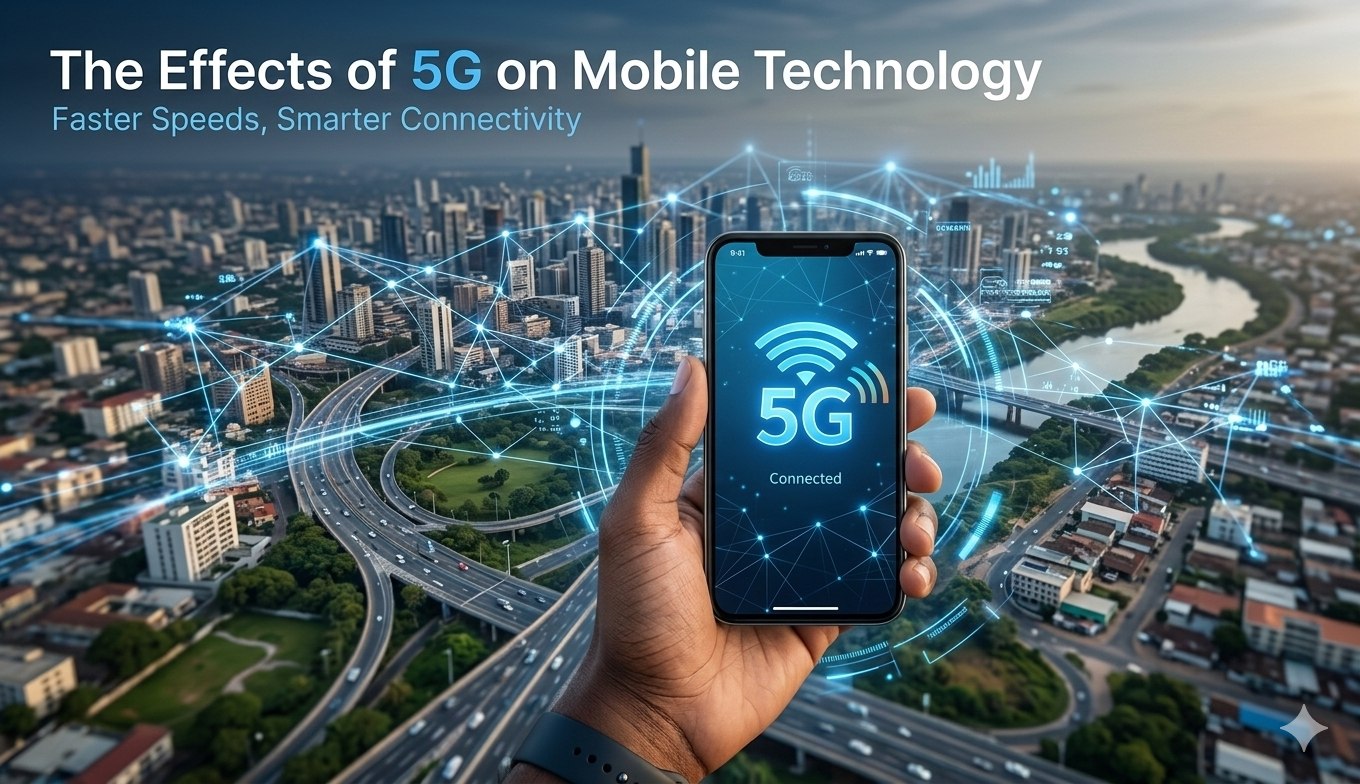
5G’s Effects On Mobile Technology In Africa
The Definitive Guide To Africa’s 5G Revolution | TechCM Electronics Store Africa | 2025–2026
A new generation of wireless connectivity is reshaping the African continent — and its effects are being felt far beyond faster download speeds. 5G, the fifth generation of mobile network technology, is arriving across Africa at a pivotal moment: a continent of 1.4 billion people, the world’s youngest population, a rapidly expanding digital economy, and a mobile-first culture that has already demonstrated to the world what is possible when connectivity meets ambition. From Lagos to Nairobi, Cairo to Johannesburg, the arrival of 5G is triggering a fundamental transformation in how Africans communicate, do business, access healthcare, manage farms, and experience the digital world. At TechCM, Africa’s number one electronics store, we have put together this comprehensive guide to 5G’s effects on mobile technology in Africa — drawing on the latest research from GSMA, Ericsson, the ITU, and leading African technology analysts to give you the full picture.
What Is 5G And Why Does It Matter For Africa?
5G is the fifth generation of wireless mobile network standards, succeeding 2G, 3G, and 4G. What makes 5G a genuine leap rather than an incremental upgrade is the combination of three transformative technical capabilities that previous generations simply could not deliver: extreme speed — theoretical peak speeds of up to 30 Gbps, compared to 4G’s 300 Mbps ceiling — ultra-low latency as low as 1 millisecond in a Standalone 5G environment, and massive device density capable of supporting up to 1,000,000 connected devices per square kilometre. These are not just technical specifications. They are the technical foundations that unlock entirely new categories of mobile applications, services, and industries that were physically impossible on older networks.
For Africa specifically, 5G’s arrival is particularly significant because the continent has consistently demonstrated an extraordinary ability to leapfrog traditional technology development stages. Africa pioneered mobile money when the rest of the world still relied on bank branches. It built mobile-first internet access when many nations were still debating fixed broadband. Now, with the right policy environment and infrastructure investment, Africa has the opportunity to leapfrog legacy fixed broadband constraints entirely — using 5G Fixed Wireless Access to deliver fibre-speed connectivity to homes and businesses that cable networks may never reach. Angela Wamola, Head of Africa at GSMA, has described 5G as “the technology that will complement other emerging technologies such as AI, blockchain, and IoT for the digitalisation of our sectors” — a statement that captures exactly why 5G is so consequential for Africa’s development trajectory.
The Current State Of 5G Across Africa In 2025–2026
Africa’s 5G rollout is gathering momentum at a pace that would have seemed ambitious just two years ago. As of late 2025, 53 operators across 29 African markets had launched commercial 5G mobile services, while 25 of those operators had additionally deployed 5G Fixed Wireless Access services. The continent closed 2025 with an estimated 54 million 5G connections — representing approximately 3.8% of total mobile subscriptions. While this figure is modest compared to Europe or Asia, it represents an acceleration from a near-standing start, with 5G accounting for less than 1.2% of Sub-Saharan African connections as recently as 2023.
The rollout is not uniform. North Africa — led by Egypt, Tunisia, and Morocco — has moved fastest, with Egypt generating over USD 700 million through 3.5 GHz spectrum auctions in 2024 alone, enabling operators including Telecom Egypt, Vodafone Egypt, Orange Egypt, and Etisalat Misr to begin serious commercial deployments. Tunisia launched commercial 5G services in early 2025, and Morocco’s regulator ANRT granted spectrum licences to Maroc Telecom, Orange, and inwi with legally binding coverage targets of 45% of the population by 2026 and 85% by 2030. In Sub-Saharan Africa, South Africa, Nigeria, and Kenya are the frontrunners, and the GSMA projects that these three countries alone will account for more than half of all 5G connections across Sub-Saharan Africa by 2030. MTN Nigeria alone had deployed over 2,100 5G base stations by 2025 as part of a USD 3.5 billion five-year infrastructure investment plan.
5G’s Major Effects On Mobile Technology In Africa
5G is not simply making existing mobile technology faster. It is enabling categories of mobile application that were technically impossible on 4G networks. Below, the expert team at TechCM, Africa’s number one electronics store, breaks down the most significant effects of 5G on mobile technology across the continent.
1. Supercharged Mobile Broadband — Faster Speeds For Every African User
The most immediately visible effect of 5G for everyday African mobile users is dramatically faster mobile internet. Where 4G delivers peak real-world speeds of around 50–150 Mbps in ideal conditions, commercially deployed 5G networks regularly deliver 300–900 Mbps to users in covered areas — with theoretical peaks approaching 30 Gbps as network densification advances. For African consumers, this means 4K video streaming with no buffering, near-instant app downloads, lag-free video calls, and smooth cloud-based productivity tools even on congested urban networks in Lagos, Nairobi, and Johannesburg where 4G capacity had already been exhausted by surging data demand.
The effect is particularly profound for mobile content creators, remote workers, and students — three of Africa’s fastest-growing digital user segments. Africa’s creator economy is exploding, with platforms like YouTube, TikTok, Instagram, and Boomplay relying on reliable high-bandwidth connectivity. 5G makes professional-quality content creation, live streaming, and cloud-based video editing genuinely feasible from a smartphone, without dependence on fixed broadband that remains unavailable or unaffordable for many African households. The consumer smartphone market is already responding: affordable 5G handsets from brands like TECNO, OPPO, Samsung, and Itel — many priced under USD 100 in 2025 — are driving a clear shift toward 5G-capable devices across South Africa, Egypt, Kenya, and Nigeria.
Key Stat: The MEA region’s 5G smartphone adoption reached 37% of shipments in Q2 2025, fuelled by sub-$100 5G devices from Chinese and African brands. Nigeria’s data consumption surged to 1.13 million terabytes in July 2025, driven by streaming on Netflix and TikTok. — Counterpoint Research / NCC Nigeria, 2025
2. 5G Fixed Wireless Access — Broadband For Underserved African Homes
If there is one 5G application that holds transformative potential specifically for Africa, it is Fixed Wireless Access — the use of 5G networks to deliver home and business broadband without physical cables. Across Africa, the challenge of building fibre-optic infrastructure to the hundreds of millions of homes in suburban, peri-urban, and rural settings is enormous — both economically and logistically. Physical fibre requires rights of way, trenching, and years of construction investment. 5G FWA requires only a base station and a receiver device at the home or business, enabling fibre-equivalent speeds to be delivered far faster and at far lower cost than traditional fixed broadband infrastructure.
By late 2025, 25 operators across Angola, South Africa, Nigeria, Kenya, Zambia, and Zimbabwe had launched commercial 5G FWA services. In South Africa, Vodacom and Rain have been particularly aggressive in targeting suburban and peri-urban households with FWA offerings that deliver speeds competitive with fibre at monthly pricing that undercuts traditional ISPs. MTN Group has targeted higher-income urban households with its 5G FWA services, generating monthly Average Revenue Per User (ARPU) of USD 24–32. Beyond residential use, 5G FWA is expanding broadband access to schools, clinics, small businesses, and community hubs in areas that traditional operators would never reach with physical cable infrastructure — with Ericsson specifically identifying FWA as a cost-effective tool for digital inclusion across Sub-Saharan Africa’s most underserved communities.
Key Stat: 5G FWA has emerged as the leading 5G application across Africa. By late 2025, 25 operators in at least six African countries had launched commercial 5G FWA services. Vodacom and Orange jointly planned up to 2,000 solar-powered base stations across rural DRC to extend FWA coverage in areas traditional economics would never reach. — GSMA / Ericsson / Tech in Africa, 2025
3. 5G And Fintech — Accelerating Africa’s Mobile Money Revolution
Africa is already the world’s undisputed leader in mobile money. Platforms like M-Pesa in Kenya and Tanzania, MTN Mobile Money (MoMo) across West and Central Africa, and Airtel Money across Eastern and Southern Africa have collectively transformed financial access for hundreds of millions of people who were previously excluded from formal banking. In 2023, mobile money transactions across Africa surpassed USD 800 billion in total value — a figure that dwarfs comparable metrics anywhere else in the world. 5G is set to supercharge this ecosystem in ways that 4G simply cannot support.
The most significant 5G fintech enabler is network slicing — a core 5G Standalone capability that allows a single physical network to operate as multiple independent virtual networks, each with its own performance guarantees and security properties. For fintech applications, this means a financial service can run on its own dedicated, highly secure, low-latency network slice that is completely isolated from general consumer traffic — dramatically reducing fraud risk and enabling real-time transaction processing at a scale and speed that opens the door to AI-driven credit scoring, instant cross-border payments, blockchain-based settlement, and high-frequency micro-transaction platforms designed specifically for Africa’s informal economy. GSMA forecasts that combined with AI, 5G could contribute up to USD 1.5 trillion to Africa’s economy by 2030 — with fintech identified as a primary beneficiary sector.
Key Stat: Mobile money transactions across Africa exceeded USD 800 billion in 2023. 5G’s network slicing capability creates dedicated, secure virtual networks for financial services — a breakthrough that is physically impossible on 4G. GSMA and Anthropic-backed AI combined with 5G could contribute USD 1.5 trillion to Africa’s economy by 2030. — GSMA, Tech in Africa, 2025
4. 5G And Healthcare — Telemedicine And Remote Diagnostics For All Africans
Africa faces one of the world’s most acute healthcare access challenges. Across Sub-Saharan Africa, rural populations can travel hours to reach the nearest clinic, specialist doctors are concentrated overwhelmingly in major cities, and diagnostic equipment in remote facilities is often minimal. 5G’s combination of ultra-low latency, massive bandwidth, and support for dense IoT device networks is creating the technical foundation for a mobile healthcare revolution that could fundamentally change this picture. With 5G connectivity, a nurse in a rural Kenyan clinic can share real-time high-definition video, patient vitals, and diagnostic imaging data with a specialist physician in Nairobi or even in another country — with a network response time of just one millisecond, making remote diagnosis as reliable as being in the same room.
African health technology startups are already developing 5G-enabled AI-powered tools for telemedicine and remote diagnostics. IoT-connected wearable health monitoring devices — blood pressure monitors, glucose sensors, ECG devices — can transmit continuous patient data over 5G to healthcare providers, enabling real-time monitoring and early intervention for chronic conditions without requiring patients to travel to facilities. Drone delivery of medicines and blood supplies to remote communities — already operational in Rwanda via the Zipline network — becomes faster, more reliable, and more scalable with 5G’s ultra-reliable low-latency network support. Healthcare is specifically identified by GSMA Intelligence as one of the three sectors expected to benefit most from 5G deployment across Africa, alongside retail and agriculture.
Key Stat: 5G supports real-time transmission of health data with 1ms latency — making remote telemedicine as responsive as in-person consultation. Africa’s rural clinics, where specialist access is severely limited, stand to benefit most. GSMA identifies healthcare as a top-three 5G beneficiary sector in Africa through 2030. — GSMA Intelligence, African Leadership Magazine, 2025
5. 5G And Agriculture — Precision Farming For Africa’s Smallholders
Agriculture remains central to Africa’s economy and food security, employing over 60% of the continent’s workforce and contributing approximately 14% of GDP. Yet African agricultural productivity is among the lowest in the world per unit of land, constrained by limited access to real-time information, unpredictable weather patterns, poor supply chain connectivity, and inadequate access to inputs. 5G’s capacity to support massive IoT sensor networks — up to one million devices per square kilometre — combined with its ultra-low latency for real-time data processing, is creating the technological foundation for a precision agriculture revolution tailored specifically to African conditions.
In Kenya and Nigeria, IoT-powered farming solutions are already being deployed at scale, with sensors monitoring soil moisture, temperature, nutrient levels, and pest activity in real time, enabling farmers to optimise irrigation schedules, reduce fertiliser waste, and intervene before crop diseases take hold. 5G extends these capabilities by supporting the simultaneous connectivity of hundreds of sensors across a single farm, enabling real-time data transmission to AI-powered crop management platforms accessible on a farmer’s smartphone. 5G-connected agricultural drones provide aerial crop monitoring, precision pesticide application, and livestock tracking across large landholdings — technologies previously available only to large-scale commercial operations that are now becoming accessible to the smallholder farmers who feed most of Africa. GSMA Intelligence specifically identifies agriculture alongside retail and manufacturing as the top sectors by expected 5G economic benefit in Africa through 2030.
Key Stat: 5G supports up to 1,000,000 IoT-connected devices per square kilometre — the foundation for precision agriculture at scale. GSMA Intelligence projects agriculture as one of the top-three African sectors by 5G economic benefit. Kenya and Nigeria lead in IoT farming deployments on the continent. — GSMA Intelligence / African Leadership Magazine, 2025
6. 5G And Smart Cities — Building The African Cities Of Tomorrow
Africa’s cities are growing at a pace unmatched anywhere in the world. Nairobi, Lagos, Kinshasa, Dar es Salaam, Accra, and Kigali are among the fastest-growing urban centres globally, adding millions of residents each decade. Managing this urban growth — providing efficient transport, reliable utilities, effective waste management, and responsive public services — is one of the defining governance challenges of the 21st century for African governments. 5G’s massive IoT capacity and ultra-low latency are making genuinely smart urban infrastructure economically and technically feasible for the first time across the continent.
Rwanda is the continent’s most ambitious example. Kigali, built on Rwanda’s Vision 2050 smart city strategy, has deployed high-speed fibre infrastructure across the capital and is integrating 5G networks to support IoT-powered traffic management, environmental monitoring, smart energy grids, and connected public services. Kenya’s Konza Technopolis — Africa’s planned silicon savannah city — is designed from the ground up around 5G and IoT infrastructure, with the Kenyan government offering significant tax incentives to attract investment. In port cities like Mombasa, Dar es Salaam, and Lagos, 5G-enabled smart port infrastructure — automated cranes controlled via dedicated 5G network slices, real-time container tracking, AI-optimised logistics — is improving the efficiency of trade infrastructure that is critical to regional economic integration. Africa’s data centre market, valued at USD 3.49 billion in 2024, is projected to nearly double to USD 6.81 billion by 2030, with Morocco, Kenya, and Nigeria leading the smart city data infrastructure expansion.
Key Stat: Africa’s data centre market will reach USD 6.81 billion by 2030 (CAGR 11.79%). Rwanda’s Kigali and Kenya’s Konza Technopolis are the continent’s most advanced smart city deployments. Smart city demand is identified as a key driver of 5G and IoT market growth across Africa. — ResearchAndMarkets / African Leadership Magazine, 2025
7. 5G And The Smartphone Market — A New Generation Of African Devices
5G is triggering a fundamental shift in Africa’s smartphone market. Smartphone penetration in Sub-Saharan Africa stood at 54% in 2024, with the GSMA projecting this to reach 81% by 2030 — a trajectory that depends critically on device prices continuing to fall. The arrival of affordable 5G smartphones from African-favoured brands is accelerating this transition faster than analysts predicted. In Q2 2025, the MEA region’s 5G smartphone adoption reached 37% of total shipments — a striking figure driven by sub-USD 100 5G devices from TECNO, OPPO, and Itel. South Africa, Egypt, and Kenya are leading this smartphone upgrade cycle, with the USD 200–599 segment capturing a 56% market share as consumers demonstrate willingness to invest in premium devices with 5G connectivity, AI capabilities, and flagship-grade displays.
The transformation is not just about speed. 5G smartphones are enabling entirely new mobile use cases across Africa: AI-powered translation for Africa’s 2,000+ languages; mobile cloud gaming on platforms designed for African consumers; professional-grade video and photo creation that is powering a new generation of African content creators and digital entrepreneurs; and seamless access to cloud productivity platforms that enable remote working and freelance digital work with global clients. On 3 March 2026, the GSMA announced pilot deployments of USD 40 entry-level 4G smartphones across six African countries — DRC, Ethiopia, Nigeria, Rwanda, Tanzania, and Uganda — with eight device manufacturers in commercial negotiations. As handset prices fall and 5G coverage expands, the device-level transformation of African mobile technology will accelerate rapidly through the remainder of the decade.
Key Stat: 5G smartphone adoption in MEA reached 37% of shipments in Q2 2025. Sub-$100 5G handsets from TECNO, OPPO, and Itel are driving rapid adoption. Smartphone penetration in Sub-Saharan Africa is forecast to rise from 54% in 2024 to 81% by 2030. — Counterpoint Research, GSMA, 2025–2026
Country-By-Country: How 5G Is Transforming Mobile Technology Across Africa
South Africa — Africa’s 5G Pioneer
South Africa is Africa’s most advanced 5G market and the continent’s benchmark for what 5G deployment at scale looks like. South Africa stands as the only African country to have announced plans to sunset both its 2G and 3G networks — by 2027 — clearing the spectrum for full 4G and 5G migration. Operators Vodacom, MTN, Rain, and Telkom SA are all actively competing in the 5G market, with Rain in particular establishing itself as a challenger brand built entirely around 5G home broadband. 5G Fixed Wireless Access has been particularly successful in South Africa’s suburbs, where it provides a genuine cable alternative. Urban areas in Johannesburg and Cape Town are already experiencing 5G network congestion, reflecting extraordinary demand — a problem of success that is driving continued densification investment. The Johannesburg data centre campus, with Teraco’s JB7 facility designed for AI workloads, is positioning South Africa as the continent’s 5G-enabled cloud and AI infrastructure hub.
Nigeria — Africa’s Largest 5G Market By Potential
Nigeria is the largest consumer electronics and mobile market in Sub-Saharan Africa, and its 5G journey reflects both the continent’s enormous opportunity and its real-world challenges. MTN, Airtel, and Mafab Communications collectively paid over USD 820 million for 5G licences in 2022. By August 2025, approximately 5.2 million of Nigeria’s 171.2 million active telephone subscribers were on 5G networks — modest penetration, but growing. MTN Nigeria alone deployed over 2,100 5G sites, backed by a USD 3.5 billion five-year investment plan. Device affordability remains the most significant barrier: entry-level 5G handsets cost NGN 160,000–200,000 ($114–143), more than three times the monthly minimum wage. However, Nigeria’s data appetite is undeniable — mobile data consumption surged to 1.13 million terabytes in July 2025, up from 1.04 million the previous month. Nigeria is projected to add 32 million new mobile internet subscribers between 2025 and 2030, making it the fourth-largest contributor to global subscriber growth behind only India, Indonesia, and China.
Kenya — East Africa’s 5G Digital Leader
Kenya has one of the most progressive telecommunications policy environments in Africa, making it a model for 5G deployment across the continent. Safaricom — also the operator behind M-Pesa, Africa’s most transformative mobile money platform — has activated 5G networks in Nairobi, Kisumu, Kisii, and Kakamega. Kenya’s technology-neutral spectrum policy, which allows operators to repurpose existing 4G spectrum for 5G without requiring new spectrum auctions, has enabled faster and more cost-effective deployment than markets that require new licensing rounds. Kenya’s Konza Technopolis smart city project represents one of Africa’s most ambitious 5G infrastructure investments, backed by government tax incentives including 10% corporate tax exemptions for the first decade. M-Pesa’s integration with 5G network capabilities — combining Africa’s most advanced mobile money platform with next-generation connectivity — positions Kenya as the continent’s leading testbed for 5G-powered fintech innovation.
Egypt — North Africa’s 5G Frontrunner
Egypt has emerged as North Africa’s undisputed 5G leader and one of the fastest-moving 5G markets on the entire continent. Between January and October 2024, Egypt’s spectrum auctions generated over USD 700 million — with Telecom Egypt, Vodafone Egypt, Orange Egypt, and Etisalat Misr all securing 3.5 GHz licences and commencing serious commercial deployments. Egypt’s proximity to Europe, combined with its Mediterranean subsea cable landing infrastructure — including the SEA-ME-WE-6 cable which completed its first Egyptian landing in July 2025 — positions it as Africa’s primary international connectivity gateway. Egypt’s data centre market is expanding rapidly, with affordable land, industrial electricity prices, and strong fibre connectivity attracting significant foreign investment. Tunisia and Morocco both followed Egypt’s lead in 2025, with nationwide 5G launches and Morocco committing legally to 85% population coverage by 2030.
Ghana — West Africa’s Stable 5G Foundation
Ghana combines political stability, a relatively robust power supply, and one of West Africa’s most conducive regulatory environments for technology investment — making it well-positioned for accelerating 5G deployment. Accra’s growing cosmopolitan professional population is driving demand for premium mobile connectivity, and Ghana’s strong mobile money ecosystem — used by millions of Ghanaians for everything from market payments to international remittances — will be a primary beneficiary of 5G’s enhanced fintech capabilities. Ghana’s stable electricity infrastructure also addresses one of 5G deployment’s primary African challenges: power reliability for base station operations.
Rwanda & East Africa — Smart Nation Ambitions
Rwanda is transforming itself into one of Africa’s most digitally ambitious nations, with Kigali serving as a continental showcase for what 5G-enabled smart city infrastructure can look like. High-speed fibre internet is widely available across Kigali, providing the backhaul foundation for 5G deployments. Between 2023 and 2025, Rwanda increased its 4G users from 500,000 to five million — one of the steepest adoption curves anywhere in Africa. Rwanda’s Vision 2050 digital strategy makes 5G infrastructure investment a national priority, with the government targeting Rwanda as a regional hub for data centres, digital services, and technology-enabled industries. TechCM ships 5G-compatible smartphones and devices to Rwanda, Uganda, Ethiopia, and across East Africa with worldwide delivery.
The Challenges Facing Africa’s 5G Rollout
Device Affordability
The single most significant barrier to 5G adoption across Africa is not network coverage — it is device affordability. A basic smartphone in Sub-Saharan Africa consumes approximately 48% of a low-income earner’s monthly income, according to GSMA estimates. Entry-level 5G handsets have been priced at USD 114–143 in Nigeria — more than three times the monthly minimum wage. While Chinese brands including TECNO, Itel, and OPPO are rapidly pushing 5G device prices below USD 100, and the GSMA’s March 2026 MoU with African operators and device manufacturers signals coordinated industry action to deploy USD 40 entry-level 4G handsets, solving the device affordability equation at mass scale remains the defining challenge for Africa’s 5G decade. TechCM stocks the most competitive range of 5G-capable smartphones across all price tiers — from accessible entry-level devices to flagship 5G handsets — at Africa’s most competitive prices.
Power Infrastructure
5G base stations require reliable mains power to operate — a significant challenge across much of Africa, where power instability affects 60–80% of tower sites. The industry is responding with solar-battery hybrid power systems and Energy-as-a-Service models that can improve tower uptime by 15–25% and cut energy costs by 20–40%. A landmark example came in July 2025, when Zoodlabs partnered with CrossBoundary Energy to deploy a solar-hybrid power solution for Sierra Leone’s first 5G network. Vodacom and Orange’s joint plan to deploy up to 2,000 solar-powered base stations across rural DRC demonstrates how renewable energy is increasingly integral to Africa’s 5G infrastructure strategy — not just as a sustainability measure, but as the only practical way to operate reliable wireless networks in regions where the grid is absent or unreliable.
Spectrum Policy And Infrastructure Costs
As of mid-2025, only 16 African nations — under 30% of the continent — had formally allocated 5G spectrum, compared to over 90% of European countries. Spectrum pricing strategies vary enormously: Egypt’s auctions generated hundreds of millions of dollars, while smaller markets charged far more modest fees. The high cost of fibre-optic backhaul infrastructure in suburban and rural areas remains a secondary constraint, though operators are increasingly adopting E-Band microwave links operating around 80 GHz as a high-capacity alternative to physical fibre. Technology-neutral spectrum policies in Kenya and Tanzania — which allow operators to repurpose existing 4G spectrum for 5G without new auctions — are emerging as the most pragmatic framework for accelerating affordable 5G deployment and are being studied as models across the continent.
5G-Compatible Devices Available At TechCM — Africa’s #1 Electronics Store
At TechCM, Africa’s number one electronics store, we stock the continent’s most comprehensive range of 5G-compatible smartphones, home broadband routers, and mobile accessories — at competitive prices with secured payment and worldwide delivery across Africa. Whether you are upgrading to a 5G smartphone in Nairobi, setting up 5G Fixed Wireless Access in Johannesburg, or exploring 5G IoT devices for your business in Lagos, TechCM has the products you need.
TechCM stocks the full range of 5G smartphones across every price tier, from entry-level 5G handsets from TECNO and Itel starting under USD 100, through mid-range Samsung Galaxy A-series and OPPO Reno 5G models at the USD 200–400 range, to flagship 5G devices including Samsung Galaxy S-series, iPhone 15/16 series with 5G, and Google Pixel 9 series. Every 5G smartphone at TechCM is genuine, certified, and compatible with African 5G network frequencies and local power standards.
For African households and businesses looking to take advantage of 5G Fixed Wireless Access — the fastest-growing 5G application across the continent — TechCM stocks a range of 5G home routers and CPE (Customer Premises Equipment) devices from leading brands including Huawei, ZTE, TP-Link, and Netgear. These devices connect to your operator’s 5G network and distribute broadband Wi-Fi throughout your home or office at fibre-equivalent speeds, without requiring any cable installation. Particularly recommended for South African suburbs and Nigerian urban households where 5G FWA operators including Rain and MTN have launched competitive home broadband plans.
TechCM stocks 5G USB dongles and portable mobile hotspot devices for professionals, travellers, and remote workers across Africa who need reliable high-speed connectivity on the move. 5G mobile hotspots deliver speeds that make video conferencing, cloud computing, and large file transfers genuinely practical from any 5G-covered location. Ideal for business professionals in South Africa, Nigeria, Kenya, and Ghana who need reliable connectivity for remote work, client presentations, and field operations.
As 5G networks expand their coverage across Africa’s major cities, TechCM stocks a growing range of IoT and smart home devices designed to leverage 5G connectivity — from smart security cameras and sensors to connected home appliances and energy management systems. For businesses, TechCM offers commercial IoT devices for fleet tracking, remote monitoring, and smart office management that benefit from 5G’s low latency and massive device-density capabilities. Browse our full IoT and smart technology range at TechCM, Africa’s number one electronics store.
What 5G Means For Africa’s Digital Future
The GSMA’s latest projections, updated at MWC Barcelona in March 2026, have nudged Sub-Saharan Africa’s 5G adoption forecast upward to 21% of connections by 2030 — equivalent to 247 million 5G connections. While this still places Africa behind every other world region, the trajectory is accelerating, and the economic stakes are significant. 5G alone is projected to contribute USD 10 billion to Africa’s economy by 2030, with the broader mobile technology ecosystem — supercharged by 5G, AI, and IoT — on a path to deliver USD 270 billion in annual GDP contribution by the same date.
The honest picture of Africa’s 5G journey in 2025–2026 is one of genuine progress constrained by real-world challenges. Infrastructure is being built — 53 operators across 29 markets have launched commercial services. Devices are getting cheaper — sub-USD 100 5G handsets are now a reality. Policy frameworks are maturing — technology-neutral spectrum policies in Kenya and Tanzania are emerging as continental models. But the usage gap remains wide, device affordability continues to constrain mass adoption, and power infrastructure is a persistent operational challenge that requires creative solutions. The opportunity is vast. Africa’s 1.4 billion people, its extraordinary youth demographic, its proven capacity for mobile innovation, and the accelerating maturity of its 5G infrastructure all point toward a decade of genuinely transformative mobile technology progress.
Why Buy Your 5G Devices From TechCM — Africa’s #1 Electronics Store
At TechCM, Africa’s number one electronics store, we stock Africa’s best selection of 5G-compatible smartphones, routers, and mobile technology from the world’s leading brands — at competitive prices with secured payment and worldwide delivery across Africa.
- Genuine, certified 5G smartphones from Samsung, Apple, TECNO, OPPO, Itel, Huawei, and Google — all compatible with African 5G network frequencies.
- 5G Fixed Wireless Access routers and CPE devices for home and business broadband across South Africa, Nigeria, Kenya, Ghana, Tanzania, and beyond.
- Competitive pricing across all 5G device categories — from entry-level 5G handsets to flagship devices.
- Secured payment options for safe and confident online shopping across Africa.
- Worldwide delivery to South Africa, Nigeria, Kenya, Ghana, Tanzania, Rwanda, Uganda, Egypt, Morocco, and beyond.
- Expert advice from our team of mobile technology specialists who understand Africa’s unique connectivity landscape.
- In-store pickup available for customers in our service areas who prefer to collect in person.
- Compatible UPS units, Wi-Fi mesh routers, and power solutions also in stock for complete 5G home setups.
Conclusion
5G is not just a network upgrade. For Africa, it is a platform for economic transformation, social inclusion, and technological leapfrogging at a scale the continent has not experienced since the arrival of mobile money. From supercharged mobile broadband and Fixed Wireless Access delivering fibre-speed internet to previously unconnected households, to 5G-enabled fintech innovations that could transform Africa’s USD 800 billion mobile money ecosystem, to precision agriculture tools that can boost smallholder farm productivity, to smart city infrastructure being built across Nairobi, Kigali, and Johannesburg — the effects of 5G on African mobile technology are profound, practical, and accelerating. The revolution is already underway, with 53 operators across 29 markets live and millions more connections coming online each year.
At TechCM, Africa’s number one electronics store, we are proud to bring Africa’s consumers the 5G-ready devices, smart home technology, and mobile connectivity solutions that will enable them to participate fully in this transformation — at competitive prices, with secured payment and worldwide delivery across the continent. The 5G era of African mobile technology has arrived. Do not be left behind.
📡 Shop 5G Smartphones & Devices — Africa’s #1 Electronics Store | Secured Payment | In-Store Pickup | Worldwide Delivery