
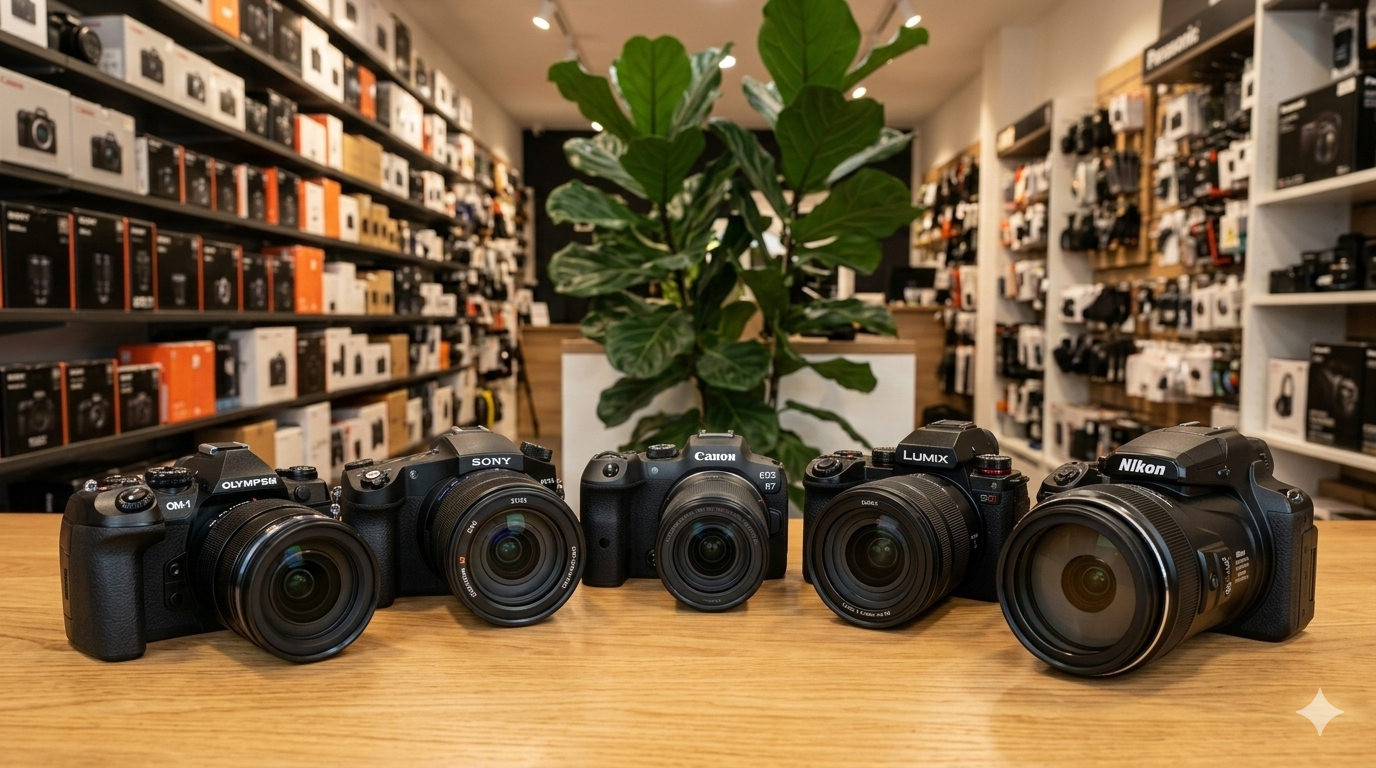
The Best Camera To Buy As A Photographer In Africa
Your Complete Camera Buying Guide For African Photographers | TechCM Electronics Store Africa | 2025–2026
Africa is one of the most visually extraordinary places on Earth. From the golden-hour light flooding across the Serengeti in Tanzania, to the neon-soaked street markets of Lagos at dusk, the mist-draped Rwenzori Mountains of Uganda, the angular geometric architecture of Cairo’s historic quarters, and the dramatic coastal cliffs of Cape Town — the continent offers photographers a near-limitless canvas of subjects, light, colour, and life. Whether you are a professional wildlife photographer working the Masai Mara, a wedding and portrait photographer building a business in Accra or Nairobi, a documentary photographer covering urban stories in Johannesburg, or an aspiring content creator capturing Africa’s beauty for a global audience — choosing the right camera is one of the most important decisions you will make. At TechCM, Africa’s number one electronics store, we have created the definitive camera buying guide for African photographers in 2025 and 2026 — covering every category, every budget, and every genre of photography specific to the African context.
Why Camera Choice Matters More In Africa Than Almost Anywhere Else
Photography in Africa presents a unique and demanding set of technical challenges that are fundamentally different from shooting in a European studio, an Asian city, or an American suburb. Africa’s light is extreme and rapidly changing — from the harsh mid-day sun of the Sahel that washes out colours and creates brutal shadows, to the magical golden hour that stretches long and dramatic near the equator, to the pitch-dark conditions of a night drive in Kruger National Park. Dust is everywhere — in the Okavango Delta, the Namib Desert, the North African erg — and penetrates camera bodies through every seam, requiring weather sealing that many consumer cameras simply do not have. Heat is relentless, stressing batteries and electronics. Distances between your subject and your lens can be extreme on a game drive, requiring telephoto reach that entry-level cameras and kit lenses cannot provide.
Yet Africa also offers enormous photographic opportunity for every type of photographer. Its street photography — from the chaotic energy of Lagos Island to the medina of Marrakech to the colourful chaos of Dakar — rewards a discreet compact camera that does not attract attention. Its portrait photography — from Maasai warriors in Kenya to Himba women in Namibia to the joyful street life of Kampala — demands a camera with beautiful skin tone rendering and excellent low-light performance. Its architectural photography, its landscape photography, its documentary photography — each places specific and different demands on the photographer’s equipment. Understanding which camera best serves your specific genre of African photography is the starting point for every recommendation in this guide from the expert team at TechCM, Africa’s number one electronics store.
Understanding Camera Categories — Which Type Is Right For You?
Before reviewing specific camera models, it is important to understand the four main categories of cameras available at TechCM, Africa’s number one electronics store, and which type of African photographer each one best serves.
Mirrorless cameras have replaced DSLRs as the professional standard for virtually every genre of photography. They use an electronic viewfinder instead of an optical mirror system, making them lighter, more compact, and capable of significantly faster autofocus — particularly for tracking moving subjects like wildlife, birds, and sports athletes. By July 2025, mirrorless cameras accounted for 97.4% of all interchangeable lens camera shipments globally, and both Canon and Nikon have formally announced the end of new DSLR development in favour of full investment in mirrorless systems. For African photographers buying a camera system in 2025 and 2026, mirrorless is the smart, future-proof choice — with expanding lens selections across Sony E-mount, Canon RF, and Nikon Z.
Digital Single-Lens Reflex cameras use a physical mirror system to direct light to an optical viewfinder. While DSLRs are now in a clear decline — shipments fell 47% year-on-year in 2025 — they remain relevant for African photographers on tighter budgets, as the shift to mirrorless has created an excellent used and discounted DSLR market. DSLR batteries also typically last far longer per charge than mirrorless cameras, an important practical advantage in remote locations across Kenya, Tanzania, Botswana, and Namibia where power access is limited. Canon DSLRs in particular remain widely sold across Africa and benefit from a vast, mature lens ecosystem including excellent third-party telephoto options from Sigma and Tamron.
Bridge cameras — also called superzoom cameras — sit between compact cameras and interchangeable-lens systems. They feature a fixed but enormously versatile telephoto zoom lens, typically covering ranges from 24mm wide-angle to 1,200mm or even 2,000mm telephoto — all in a single, lightweight body. For African safari and wildlife photographers who do not want to carry multiple lenses or invest in expensive telephoto glass, a bridge camera like the Nikon Coolpix P950 (with a 24–2000mm zoom) or Canon PowerShot SX70 HS delivers extraordinary telephoto reach at a fraction of the cost of an equivalent mirrorless telephoto setup. Their limitations — smaller sensors and slower autofocus versus mirrorless — are acceptable trade-offs for casual and travel photographers who prioritise simplicity and reach.
Premium compact cameras — particularly the Fujifilm X100VI, Sony RX100 VII, and Ricoh GR IIIx — offer remarkably high image quality in a pocket-sized body that attracts far less attention than a mirrorless camera with a large lens. For street photography in Lagos, Cairo, Dakar, and Nairobi — where a conspicuous camera can attract unwanted attention or alter the natural behaviour of your subjects — a discreet compact camera can enable candid, authentic photography that would be impossible with a larger system. The compact camera market experienced a striking recovery in 2024, with shipments jumping from 1.7 million to 2.9 million units globally — driven substantially by the extraordinary popularity of Fujifilm’s X100 series.
The Best Cameras For African Photographers — Full Category Reviews
1. Sony Alpha a7 V — Best Overall Full-Frame Mirrorless For Africa
Sony launched the a7 V in late 2025 to widespread critical acclaim, with DPReview describing it as “one of the most balanced full-frame hybrids available” and noting its “powerful Swiss Army knife” versatility for virtually every genre of photography and video. At the heart of the a7 V is a 61-megapixel partially-stacked full-frame sensor — the same class of sensor found in the renowned Sony a7R V — delivering extraordinary resolution with improved autofocus speed over previous generations. For African photographers, the resolution advantage is immediately meaningful: wildlife images can be heavily cropped in post-production to isolate a distant subject without losing print quality, and landscape images of the Drakensberg, the Okavango, or the Sahara carry staggering detail. Sony’s AI-powered subject detection autofocus — capable of tracking birds, animals, insects, and humans with equal reliability — makes it a supreme performer for wildlife photography.
The a7 V’s 8-stop in-body image stabilisation (IBIS) is one of the most effective stabilisation systems available in any camera, enabling handheld shooting at shutter speeds that would produce blurred images on any unstabilised body. For African photographers working from moving safari vehicles — one of the most common and challenging wildlife photography scenarios — this stabilisation is a genuine practical advantage that translates directly into sharper images. Sony’s E-mount lens ecosystem is the most comprehensive in the mirrorless world, with an enormous range of native Sony G Master lenses and excellent third-party options from Sigma and Tamron, giving African photographers access to every focal length they could possibly need. Sony holds 29.8% of the global mirrorless market — the second-largest share after Canon — reflecting the brand’s dominant position in professional photography worldwide.
Best For: Professional and serious enthusiast photographers in South Africa, Kenya, Nigeria, and Egypt who need the highest-resolution full-frame camera for wildlife, landscape, wedding, and commercial photography.
2. Canon EOS R6 Mark III — Best All-Round Camera For African Working Photographers
The Canon EOS R6 Mark III launched in 2025 and immediately established itself as one of the most highly rated cameras of the year. DPReview awarded it top position in its best cameras under USD 3,000 guide, describing it as “such a complete package” that “it’s hard to imagine you’ll find that the EOS R6 III holds you back” regardless of subject matter or shooting style. RedSharkNews’ Metascore tracking placed it among the most consistently praised cameras across multiple expert review outlets in 2025, highlighting its reliable strong image quality, excellent low-light performance, and autofocus that handles demanding subjects without drama. Canon’s ergonomics — praised for making cameras genuinely comfortable to shoot with for extended periods — are a real-world advantage for African wedding photographers working 10-hour events in the heat of Lagos or Accra, and for wildlife photographers spending full days on a game vehicle in Kruger or the Mara.
Canon accounts for 46.5% of global camera sales — nearly half the entire market — and this dominance is reflected strongly across Africa, where Canon’s service network, lens availability, and brand familiarity make it the most practical choice for photographers concerned about after-sales support on the continent. Canon’s RF lens ecosystem continues to grow and is now widely considered one of the strongest in the mirrorless world, with options from affordable kit zooms to the breathtaking Canon RF 100–300mm f/2.8 L IS USM — described by professional Africa wildlife photographer Paolo Sartori as producing “bokeh that is just dreamy” and recommended as his primary 2025 safari lens of choice. For African photographers who want a camera that excels at everything — wildlife, portrait, wedding, event, street, and video — and is backed by the world’s most widely supported camera brand, the EOS R6 Mark III is the definitive recommendation.
Best For: Working photographers, wedding and portrait photographers, wildlife enthusiasts, and content creators across Africa who want the most versatile, reliable full-frame mirrorless system backed by the world’s largest camera brand.
3. Nikon Z8 — Best Camera For African Wildlife & Safari Photography
For African wildlife photographers specifically, the Nikon Z8 stands in a class of its own at a price point that stops short of the flagship Z9. Professional photographer and writer at The Cotswold Photographer — who personally owns and has extensively used the Z8 alongside multiple competing systems — describes it plainly as delivering “the best full-frame image quality available for under $3,500” and calls its subject detection “extremely reliable and more confident than the Z6III when tracking fast-moving subjects.” For wildlife photography in Africa — where your subject may be a cheetah accelerating to 110km/h across the Serengeti, a fish eagle diving into Lake Naivasha, or a pod of hippos erupting from a Zambezi waterhole — this tracking reliability and 20fps RAW burst rate means you simply do not miss the shot. The stacked sensor’s elimination of rolling shutter is a further technical advantage: when panning a fast-moving animal, cameras with rolling shutter produce a distorted “jelly” effect that ruins the image — the Z8 eliminates this problem entirely.
Thomson Safaris trip leader and professional wildlife photographer Don Toothaker singles out the Nikon Z9 — the flagship above the Z8 — as “superb” for Africa, noting that “it works well for all animals, regardless of size” and that “you’ll get gorgeous pictures of everything, from something as big as a pride of lions or as small as a little bee-eater on a branch.” The Z8 delivers nearly all of the Z9’s capabilities in a smaller and lighter body, at a saving of over USD 1,000 — making it the pragmatic choice for photographers who want flagship wildlife performance without flagship bulk and expense. The Z8’s backlit buttons — rarely found at this price level — are invaluable for pre-dawn game drives and night photography in South Africa, Kenya, and Tanzania. Nikon’s Z-mount lens system includes what independent reviewers consistently call the best 24–70mm f/2.8 on the market, alongside strong telephoto options for the long reach that African wildlife demands.
Best For: Dedicated wildlife, safari, and bird photographers across Africa — especially those working in the Serengeti, Masai Mara, Kruger, Okavango, and other major game areas where autofocus tracking and burst speed are paramount.
4. Fujifilm X-T5 — Best Mid-Range Camera For African Photographers
The Fujifilm X-T5 has earned a passionate following among photographers worldwide — and for very good reason. DPReview calls it “a stills-centric handling and features masterpiece” and includes it in both its best mirrorless cameras and best cameras under USD 2,000 guides, concluding that “for photographers who enjoy Fujifilm’s traditional dial-based controls, there’s no more capable body than the X-T5.” Its 40-megapixel APS-C sensor delivers image quality that challenges many full-frame cameras, producing files with exceptional sharpness, colour depth, and dynamic range that are perfect for Africa’s visually complex environments — from the rich earth tones of the Sahel to the vivid fabrics of a West African market. The X-T5’s film simulation modes — which replicate the colour science of classic Fujifilm film stocks including Velvia, Provia, Classic Chrome, and Eterna Cinema — produce JPEG files with a distinctive, organic aesthetic that sets them apart from the clinical output of many digital cameras and resonates strongly with the storytelling demands of African documentary and editorial photography.
For African photographers who travel light — the X-T5’s compact, lightweight body being a major advantage over bulky full-frame systems on walking safaris, overland journeys, and street photography assignments — the practical advantages are significant. Its APS-C sensor format provides a natural 1.5x crop factor, giving every lens more apparent reach — a 200mm telephoto lens effectively becomes 300mm, which is genuinely useful for wildlife photography without requiring an expensive and heavy dedicated super-telephoto lens. The X-T5’s physical exposure dials — dedicated controls for ISO, shutter speed, and exposure compensation that operate independently of the menu system — allow rapid, tactile adjustments that are invaluable when light shifts suddenly during golden hour on the Mara or when a street photography opportunity presents itself without warning in Addis Ababa or Kigali.
Best For: Enthusiast and semi-professional photographers in South Africa, Kenya, Ghana, and Tanzania who want exceptional image quality in a compact, lightweight body with an outstanding user experience — particularly suited to travel, documentary, street, and landscape photography.
5. Canon EOS R10 — Best Budget Mirrorless For Emerging African Photographers
The Canon EOS R10 is the smartest entry point into professional-grade mirrorless photography available at TechCM, Africa’s number one electronics store. Engadget’s camera expert calls it “my top pick under $1,000” and notes that it “delivers 4K 10-bit at 30p with supersampling and no crop, or 4K 60p” — video specifications that are extraordinary for a camera at this price level, and that make it a genuine tool for African content creators and videographers as well as photographers. Its 23fps electronic shutter burst rate means it can capture fast-moving subjects — from birds in flight over Victoria Falls to athletes on a South African running track — at a speed that would have required a professional-grade camera just a few years ago. Canon’s Dual Pixel AF with subject recognition ensures sharp focus across photo and video modes, tracking humans, animals, and birds with confidence.
For African photographers who are either starting their photography journey, upgrading from a smartphone, or building their first dedicated camera system on a constrained budget, the EOS R10’s combination of Canon’s RF lens ecosystem compatibility, professional video specifications, and strong image quality represents extraordinary value. Its fully articulating screen — which flips out to face the photographer for vlogging and selfies — makes it particularly well suited to the content creation use cases that are driving camera demand across Africa’s growing social media and YouTube creator communities in Lagos, Nairobi, Accra, and Johannesburg. As African photographers invest and develop their skills, they can gradually add Canon RF lenses and eventually upgrade to a higher-end Canon RF body — keeping all lenses across the same mount system.
Best For: First-time mirrorless buyers, photography students, social media content creators, and emerging photographers across Africa who want a future-proof entry into Canon’s RF ecosystem at an accessible price point.
6. Nikon Z5 II — Best Value Full-Frame Camera In Africa
DPReview’s reviewer calls the Nikon Z5 II “almost unimaginably good for a camera priced under $2,000” — and the evidence backs this assessment. The Z5 II pairs Nikon’s latest-generation autofocus system with a 24MP full-frame BSI CMOS sensor in a body with deep, comfortable ergonomics that make it a pleasure to use during long shooting sessions. Its autofocus performance is described by DPReview as “very good, especially in subject recognition modes” and “light-years better than even higher-end cameras from just a few years ago” — a statement that underlines how dramatically mirrorless autofocus technology has advanced. Nikon updated the Z5 II in 2025 with its latest processor and an upgraded sensor alongside boosted video specifications, ensuring it remains competitive against newer rivals at its price tier.
For African photographers who want the image quality advantages of a full-frame sensor — larger dynamic range, better low-light performance, shallower depth of field for portrait and wildlife photography — but cannot justify the USD 2,500+ cost of a Canon R6 III or Sony a7 V, the Nikon Z5 II represents the most compelling full-frame value proposition currently available. Its deep grip makes it comfortable with Nikon’s excellent telephoto zoom lenses, including the NIKKOR Z 100–400mm f/4.5–5.6 VR S — a lens praised by wildlife photographers for its reach and optical quality at a price that is significantly more accessible than equivalent Canon or Sony telephoto options. For portrait photographers in Lagos and Nairobi, landscape photographers across South Africa and East Africa, and wedding photographers building a professional kit on a budget, the Z5 II is an outstanding platform.
Best For: Budget-conscious professional and enthusiast photographers across Africa who want a full-frame sensor and the image quality advantages it brings, without stretching to the premium tier of Canon, Sony, or Nikon’s flagship lines.
7. Fujifilm X100VI — Best Compact Camera For African Street Photography
The Fujifilm X100VI is one of the most talked-about cameras of 2024 and 2025 — and it is particularly well suited to the specific demands of African street, documentary, and travel photography. Engadget calls the X100VI “a near-perfect update” to the X100 V, praising its 40-megapixel sensor and in-body image stabilisation as meaningful improvements that make it “especially pleasing” for street and tourist photography. The compact camera market’s stunning recovery in 2024 — from 1.7 million to 2.9 million units — was driven substantially by the X100 series’ cult popularity, reflecting a genuine photographer desire for a high-quality camera that does not draw attention in the way that a mirrorless camera with a large lens inevitably does.
For African street and documentary photographers, the X100VI’s discreet rangefinder design is a significant practical advantage. In cities like Lagos, Marrakech, Dakar, and Addis Ababa, a small, unassuming camera enables candid photography of everyday life that accurately reflects the authentic energy of African urban environments — images that are fundamentally different from what is possible when subjects see a large camera approaching. The fixed 23mm f/2 lens — equivalent to 35mm on full-frame — is one of the classic street photography focal lengths, producing images with a naturally wide perspective and beautiful subject-background separation at its maximum aperture. Fujifilm’s film simulation modes on the X100VI produce JPEG images with such outstanding aesthetic quality that many professional photographers deliver them directly to clients without post-processing — an enormous time advantage for editorial and documentary photographers working across multiple African countries.
Best For: Street photographers, documentary photographers, travel photographers, and journalists working across Africa who want exceptional image quality in a discreet, pocketable camera that blends into urban environments.
8. Nikon Coolpix P950 — Best Safari Bridge Camera For Budget Wildlife Photographers
For African safari visitors, wildlife enthusiasts, and photographers on tighter budgets who need extraordinary telephoto reach without the cost or complexity of an interchangeable-lens system, the Nikon Coolpix P950 is one of the most practical camera recommendations available. Its extraordinary 24–2000mm optical zoom range — equivalent to 83x magnification — covers every possible safari scenario in a single lens: wide-angle 24mm for sweeping savannah landscapes, 200–400mm for most animal close-ups, and 2000mm for extreme telephoto shots of distant birds and elusive big cats that would require a USD 10,000+ professional telephoto lens on a DSLR or mirrorless system. Thomson Safaris’ Andrew Doherty credits professional safari photographer Don Toothaker’s recommendation of the P950 with transforming his safari photography from smartphone snapshots to genuinely impressive wildlife images — a transformation many African safari tourists can make without the investment and complexity of a full mirrorless system.
Full Suitcase travel photographer Jurga Rubinovaite, who has guided photographic safaris across Africa for many years, specifically recommends the P950 as “one of the best price/quality point-and-shoot cameras” for safari, noting that it “covers most situations — from landscapes to wildlife close-ups.” For African photographers planning wildlife trips to Kenya, Tanzania, Botswana, Namibia, and South Africa who do not want the expense, weight, or technical learning curve of an interchangeable-lens system, the P950 delivers an immediately practical and highly capable alternative. It also shoots 4K video — making it suitable for the growing African travel vlogging community documenting their experiences across the continent.
Best For: Safari tourists, wildlife enthusiasts, travel bloggers, and budget-conscious photographers across Africa who want extreme telephoto reach in a single, simple, affordable camera for game drives, birdwatching, and travel photography.
9. Canon EOS R5 Mark II — Best Professional Camera For African Commercial Photography
The Canon EOS R5 Mark II is the definitive professional camera for African commercial, wildlife, and documentary photographers who demand the absolute best from their equipment and have the budget to match. Digital Camera World’s wildlife photography expert calls it their “personal pick” for wildlife photography, praising it for having “the best autofocus on this list, along with phenomenal photo and video quality, along with all-important weather-sealing.” Professional Africa wildlife photographer Paolo Sartori uses the R5 as his primary body for wide and mid-range work on safari, pairing it with the Canon RF 100–300mm f/2.8 L IS USM for what he describes as a setup that is “fast, bright, responsive” with the “dreamiest bokeh.” Its 45MP resolution, 8K internal RAW video, and class-leading autofocus system make it the choice of National Geographic photographers, BBC Natural History Unit camera operators, and Africa’s top commercial photographers.
For African photographers who earn their living from photography — producing images and video for international brands, tourism boards, editorial publications, conservation organisations, and advertising agencies — the R5 Mark II is the tool that meets every professional brief. Its 8K RAW video output provides the resolution needed for cinema-grade documentary work — increasingly important as African conservation organisations and tourism boards commission high-end visual content for global audiences. The RF mount’s growing lens ecosystem — including some of the most optically advanced lenses ever manufactured — ensures that photographers who invest in the R5 Mark II will have access to increasingly capable glass as Canon continues to develop its RF professional lineup through the remainder of the decade.
Best For: Professional commercial photographers, wildlife photographers, documentary filmmakers, and photojournalists across Africa who require the absolute highest level of image quality, autofocus performance, and video capabilities for professional assignments.
Africa-Specific Camera Buying Considerations
Weather Sealing Is Non-Negotiable For African Conditions
Dust, rain, and humidity pose serious threats to camera electronics across Africa. From the fine dust of the Kalahari and Sahara that infiltrates every unsealed joint in a camera body, to the sudden tropical downpours that drench the Rwandan highlands, to the coastal salt air of Mombasa and Cape Town — African shooting conditions test camera weather sealing in ways that a studio photographer in Amsterdam or Tokyo will never experience. Every camera recommended in this guide has at minimum a degree of weather resistance. For serious field work, look specifically for cameras rated to IPX4 or above, with fully sealed body joints and gasket-protected buttons — as found on the Nikon Z8, Canon R5 Mark II, R6 Mark III, and Sony a7 V. The Digital Camera World wildlife expert explicitly advises: “You’ll need weather-sealing — trust me, you’ll need it shooting in the wild.”
Telephoto Reach For Wildlife Photography
Professional safari photographers universally agree that telephoto reach is the single most important equipment consideration for African wildlife photography. ROAR Africa’s photography guide recommends a minimum zoom range of 200–500mm for most game drive scenarios, while Paolo Sartori advises that his primary safari lens is the Canon RF 100–300mm f/2.8 L IS USM with a 1.4x teleconverter as his base setup, with a 600mm prime for extreme action and small birds. The rule of thumb shared by wildlife photography experts at African Safari Pictures is counter-intuitive but consistently validated: it is better to invest more money in telephoto glass than in the camera body, as the lens fundamentally determines reach and optical quality in a way that sensor resolution cannot compensate for. TechCM stocks a comprehensive selection of telephoto lenses from Canon, Nikon, Sony, Sigma, and Tamron for every budget.
Battery Life In Remote Locations
Remote game lodges, bush camps, and overland safari vehicles across Kenya, Tanzania, Botswana, Zimbabwe, and Namibia often have limited power access — a single 12V socket in a game vehicle, a solar-charged power bank in a tent camp, or generator power limited to a few hours each evening. Mirrorless cameras consume battery power significantly faster than DSLRs, making battery management a critical practical consideration. Always carry a minimum of three spare batteries for a multi-day safari. Nikon’s Z8 and Z9 use larger battery formats that deliver longer life per charge than competing Sony and Canon mirrorless bodies — a meaningful advantage for full-day game drives. TechCM stocks genuine manufacturer batteries and multi-slot chargers for all major camera brands, essential accessories for any African photographer working in remote locations.
Heat, Humidity, And Electronics
Africa’s equatorial and tropical climates — encompassing most of Central Africa, East Africa, West Africa, and the coastal regions of Southern Africa — expose camera electronics to operating temperatures and humidity levels well above what the manufacturer assumes for the majority of use cases. Never leave a camera in a parked vehicle in direct sunlight, where interior temperatures can exceed 70°C — far above the operating temperature limits of any camera battery or sensor. Use a camera bag with thermal insulation when not shooting. Silica gel desiccant packs placed inside camera bags help manage humidity in the Rwandan highlands, the coastal tropics of Mombasa and Dar es Salaam, and the rainforests of the Congo Basin. TechCM stocks camera bags, dry boxes, and desiccant accessories specifically suited to African shooting conditions.
Best Camera By African Photography Genre
Best Choice: Nikon Z8 (professional) / Canon EOS R6 Mark III (enthusiast) / Nikon Coolpix P950 (budget). Wildlife photography demands fast, reliable subject-tracking autofocus, high burst rates (15fps minimum), telephoto reach of 400mm+, weather sealing, and strong low-light performance for dawn and dusk game drives. The Nikon Z8’s 20fps RAW burst, stacked sensor eliminating rolling shutter, and extraordinary subject tracking make it the top wildlife body at its price. At budget level, the P950’s 2000mm zoom reach is unmatched for the price.
Best Choice: Canon EOS R6 Mark III (primary recommendation) / Sony a7 V (alternative). Wedding and portrait photography across Africa demands beautiful skin tone rendering in a continent with enormously diverse skin tones — from the deep rich tones of West and Central African subjects to the lighter tones of North Africa. Canon’s colour science, refined over decades, is specifically praised for producing natural, flattering skin tones across all ethnicities. The R6 III’s reliable autofocus tracking ensures sharp focus on faces during the fast-moving chaos of a Nigerian wedding or a Ghanaian traditional ceremony. Its weather sealing withstands the outdoor ceremonies common across African wedding traditions.
Best Choice: Fujifilm X100VI (compact, discreet) / Fujifilm X-T5 (interchangeable lens). Street photography across Africa’s teeming cities rewards small, discreet cameras that do not attract attention. The X100VI’s rangefinder form factor and fixed lens make it far less conspicuous than any mirrorless system with a large attached lens. Fujifilm’s film simulation modes produce images with a distinctive documentary aesthetic — organic, filmic, and instantly compelling — that suits African photojournalism and social documentary work. For photographers who need interchangeable lenses for documentary assignments across multiple environments, the X-T5 offers the same exceptional Fujifilm colour science in a more versatile package.
Best Choice: Sony a7 V (61MP, maximum resolution) / Nikon Z8 (45MP, best dynamic range). Africa’s landscape and architectural photography rewards the highest available resolution and dynamic range — the 61MP Sony a7 V delivers extraordinary fine detail in images of the Drakensberg escarpment, the Saharan dunes, or the intricate geometric tile work of Moroccan medinas, while files can be cropped aggressively in post-production. The Nikon Z8’s base ISO 64 — described by The Cotswold Photographer as delivering “medium-format-like latitude with beautiful tonality, rich shadow detail, and incredibly clean files” — makes it particularly special for landscape work where tonal gradation in skies and shadows defines the image.
Best Choice: Canon EOS R10 (budget) / Canon EOS R6 Mark III (professional). Africa’s booming content creator economy — YouTube channels, Instagram photography, travel vlogs, and brand social media content — is driving significant camera demand from creators who need strong video quality alongside photo capability. The Canon R10 delivers 4K 10-bit video at USD 799 with a fully articulating screen ideal for vlogging — making it the outstanding budget choice for African content creators. The R6 Mark III offers professional-grade 4K 60p RAW video for creators working on brand campaigns, tourism content, and commercial assignments. The Panasonic Lumix S1 II — described by PetaPixel’s Jordan Drake as “the most powerful mirrorless video camera on the market” in 2025 — is also available at TechCM for dedicated video-first creators.
Why Buy Your Camera From TechCM — Africa’s #1 Electronics Store
At TechCM, Africa’s number one electronics store, we stock Africa’s most comprehensive selection of cameras, lenses, and photography accessories from the world’s leading brands — including Canon, Nikon, Sony, Fujifilm, Panasonic, and more — at competitive prices with secured payment and worldwide delivery across the continent.
- Genuine, certified cameras and lenses from Canon, Nikon, Sony, Fujifilm, Panasonic, and Sigma — all compatible with African power standards and backed by manufacturer warranties.
- The full range of camera categories — from professional full-frame mirrorless systems to budget entry-level bodies, bridge cameras, and premium compacts.
- Telephoto lenses, wide-angle lenses, portrait primes, and zoom lenses across all major camera mounts — including third-party options from Sigma and Tamron for maximum value.
- Camera bags, weather-sealed cases, dry boxes, and desiccant packs suited to Africa’s demanding climate conditions — dust, heat, humidity, and tropical rain.
- Spare batteries, multi-slot chargers, and portable power solutions for remote safari and field photography in locations with limited power access.
- Tripods, monopods, beanbags, and vehicle clamps for stable telephoto shots on game drives and landscape photography.
- Memory cards, card readers, and field storage solutions for managing large RAW files during multi-day shoots.
- Expert advice from our team of photography specialists who understand Africa’s unique shooting environments and the specific demands they place on camera equipment.
- Secured payment options for safe online shopping across South Africa, Nigeria, Kenya, Ghana, Tanzania, Rwanda, Egypt, Morocco, and beyond.
- Worldwide delivery and in-store pickup across Africa — ensuring every photographer on the continent can access the gear they need.
Conclusion
Africa is one of the most photographically extraordinary continents on Earth — and it deserves cameras that can do it justice. Whether you are tracking a leopard through the dappled light of the South Luangwa Valley, capturing the joyful chaos of a Lagos street market, documenting the human stories of Nairobi’s Kibera neighbourhood, photographing the breathtaking geometric architecture of Marrakech, or building a portrait photography business in Accra — the camera you choose shapes not just the technical quality of your images, but your ability to respond instinctively, work efficiently, and focus on the art of photography rather than fighting your equipment.
The global camera market has never offered African photographers better choices. Mirrorless technology now accounts for 97.4% of professional camera shipments, delivering autofocus performance, image quality, and video capabilities that were science fiction a decade ago. The Middle East and Africa camera market is growing at 4% annually, South Africa’s photography equipment market is expanding at 8.5% — the numbers reflect a continent of photographers whose visual ambitions are growing as fast as their access to world-class tools. From the Nikon Z8 for the serious wildlife photographer to the Canon EOS R10 for the emerging content creator, and from the Fujifilm X100VI for the street photographer to the Nikon P950 for the safari adventurer — TechCM has the perfect camera for every African photographer, at every budget, available with secured payment and worldwide delivery across the continent. Your greatest image is still ahead of you — make sure your camera is ready for it.
📷 Shop Africa’s Best Camera Selection — Africa’s #1 Electronics Store | Secured Payment | In-Store Pickup | Worldwide Delivery